
County Records Box Lists
The State Archives of North Carolina is custodian to many county records transferred from county courts or offices. These records include legal records such as wills, estates, civil and criminal actions, court minutes, and divorces. These records also include records created by Registers of Deeds, including land records and marriage records.
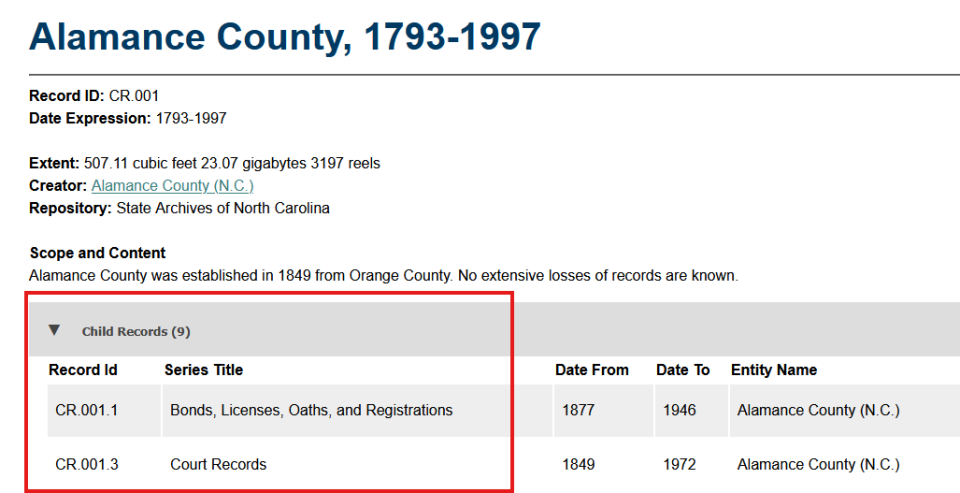
In the tabs below you will find links to each county homepage in the Discover Online Catalog (DOC), which contains information about those records as grouped into series by record type. Click on “Child Records” to see a listing of records available for each county.
Record Type Indexes
Most county records are not arranged by the names of persons included in the record. However, many county records have corresponding index volumes, created by the Clerk of Court or the Register of Deeds, where researchers can search for specific individuals. Those indexes are inventoried in the Discover Online Catalog.
Archives staff have created indexes for names in selected county records. These indexes are currently undergoing revisions as archivists add this information to our online indexes to increase their searchability.
The information below provides a listing of these indexes by record type. During this revision process, please contact us at archives@dncr.nc.gov to search for a specific name on one of the indexes listed below or for a full index.
As records series are arranged and described, additional container lists will become available on this page. Have you found an item in a container list that you would like to see? You can visit the State Archives in person to do further research or order copies online.
Civil Action files contain records pertaining to court proceedings involving a personal dispute between a plaintiff and a defendant or those involving an individual’s application to the court. Some civil action suits are maintained separately as their own category, such as Divorces and Civil Actions Pertaining to Land.
Note: further processing in this series is not planned at this time.
Coroners' Inquests are records of coroners’ investigations into deaths, especially those that were sudden or could result in court cases. They often include not only the coroner’s statements but also those of witnesses, relatives, family and medical professionals. The earliest Coroner’s Inquests are located in the Secretary of State Papers.
Note: further processing in this series is not planned at this time.
Criminal Action files contain records pertaining to court proceedings prosecuted by the State and involve violations of the law such as murder, riot, burglary, larceny, forgery and others. They are categorized as felonies or misdemeanors depending on their severity.
Note: further processing in this series is not planned at this time.
CRX records are any county records that have been out of the legitimate chain of custody before being incorporated into the State Archives. The Archives will not certify these records; however, this is not a judgment of their informational or historical validity, but a condition of their legal integrity.
All CRX records are listed in the Discover Online Catalog (DOC). To access by county, please see the tabs above. Please note that most CRX records are not indexed by the names of individuals included in the records.
Divorces have fallen within the jurisdiction of county courts since 1835. Earlier divorces prior to 1835 are found in the General Assembly Session Records. Processed divorce records are arranged alphabetically. Unprocessed divorce records are arranged by case number, usually within civil actions. Court officials created indexes for divorces and civil actions, which are available for review in the Archives Search Room, typically on microfilm.
Estate records are legal documentation of the disposition of a deceased person’s property sometimes including records of orphans and legal proceedings that occur after an estate is closed. The estates index focuses on processed records. Processed estates are typically arranged alphabetically unless noted. Unprocessed estates are typically arranged by file number and can include separate records of inventories, administrators, and executors.
Guardian records are records surrounding the appointment and legal administrations of a guardian of an individual, most often a minor, who has inherited property but is unable to handle it due to age or infirmity. In the case of orphaned children, these records are often included in Estates.
Inheritance Tax records are twentieth-century records of settlements of tax assessed on estates worth more than $2,000. They include the name of the deceased and administrator or executor, approximate valuation of estate, and the heir or devisees. Loose papers concerning inheritance tax are also filed in Estates for many counties.
Note: further processing in this series is not planned at this time.
Marriage records in North Carolina differ by date. Before 1868, couples obtained marriage bonds, which were statements of intent to marry that were attested by the prospective groom before the clerk of court in the bride’s county of residence. Marriage bonds are indexed statewide. In 1868, North Carolina standardized the process of obtaining a marriage license and phased out the marriage bond process. The information contained in marriage licenses varies across counties and time periods, and though the amount of information has increased over the years, the accuracy was dependent on the person applying for the license. The State Archives has marriage license indexes or marriage registers created by the Registers of Deeds for most counties available by request, in addition to the indexes listed below. A third kind of marriage record, cohabitation bonds, concerns the legal acknowledgment of preexisting marriages of formerly enslaved persons under the statue of 1866.
Miscellaneous Records contain a variety of records including those that do not fall easily into the main record categories as well as those that were in too small of a quantity to be catalogued separately. Examples are records of enslaved persons and free persons of color; bills of sale; promissory notes; canal and drainage records; shipping and fishing records; mill records; mining records; timber records; powers of attorney; grand jury records; and witness tickets. Many box and volume titles may be unique to one or two counties.
All miscellaneous county records are listed in the Discover Online Catalog (DOC) by county and by type of record in the scope and content note of the series page. To access by county, please see the tabs above. Please note that most miscellaneous records are not indexed by the names of individuals included in the records.
Widows' Year’s Support files contain records relating to the apportionment of widows’ dower rights in the real property of her deceased husband, and the allocation of a sufficiency of provisions to enable her to support herself and family during the first year after his death, while the estate was being settled. North Carolina abolished the dower in 1960. In some counties these records are maintained in Estates or Special Proceedings.
Note: further processing in this series is not planned at this time.
Since 1760, original wills were under the jurisdiction of the county in which it was probated. Prior to 1760, wills were filed with the Secretary of State and are maintained with these records. When an individual died without a will, the probate of their estate is maintained in separate Estate files.
You may find these in the Mitchell's Will Index, the statewide will index for dates up to the year 1900.